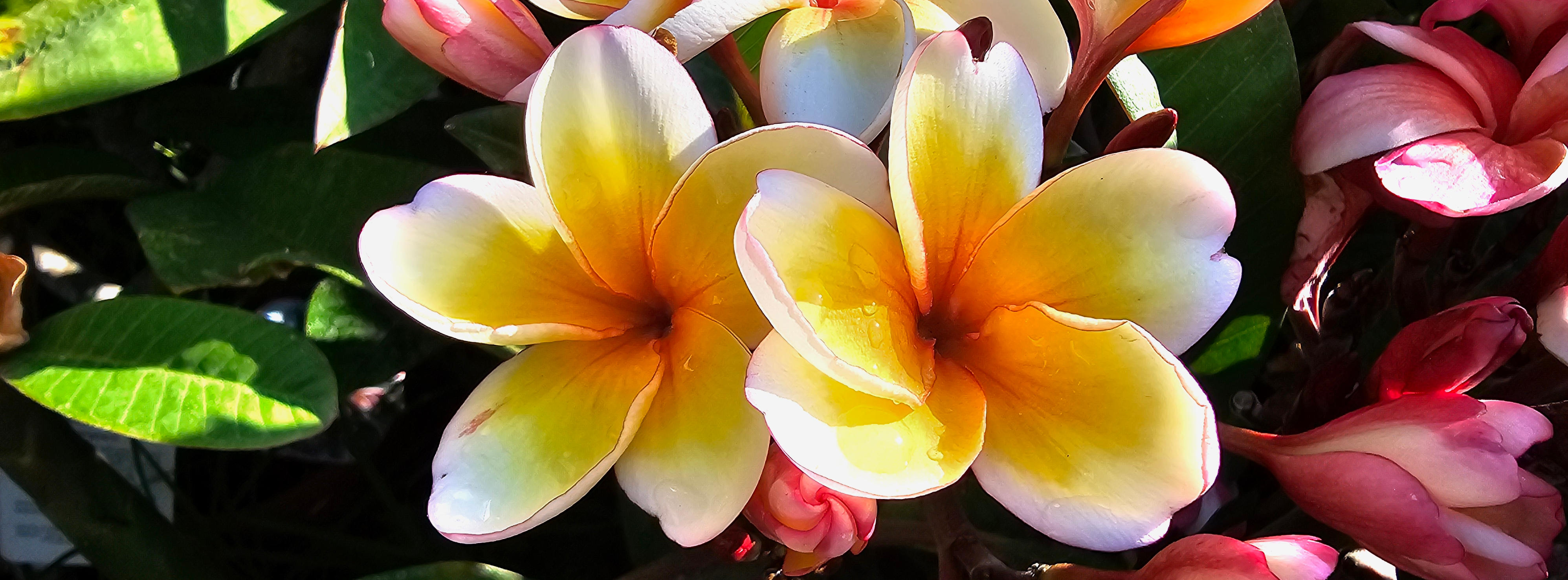
Auf dieser Seite möchten wir allen Plumeria / Frangipani Freunden eine einfache Übersicht über die notwendigen oder optionalen Schritte geben, die in der jeweiligen Jahreszeit wichtig sind bzw. empfohlen werden, damit sich die Pflanzen wohl fühlen und uns dann regelmäßig mit Blüten beschenken. Januar bis Anfang April können wir uns noch ruhig zurück lehnen. Es gibt kaum etwas zu tun. Unsere Plumerias befinden sich noch in der Winterpause und außer einer wöchentlichen Stippvisite auf Fäulnis oder andere eventuell sichtbaren Krankheiten, haben wir keine Aufgaben. Ende April werden unsere Pflanzen langsam aus der Winterruhe erwachen, was man an den frischen grünen Trieben gut erkennen kann. Nun kann man ganz langsam mit leichten Wassergaben beginnen und die Pflanzen, wenn sie nicht schon am Fenster stehen, nun wieder an eine helle Stelle ins Zimmer stellen. Für den Balkon / die Terrasse ist es noch zu kalt. Raus dürfen sie erst wenn es stabile 8°C – 10°C Nachttemperaturen gibt. Dünger geben wir ihnen erst, wenn die ersten beiden Blätter gut sichtbar ausgebildet sind. Wenn Sie einen Langzeitdünger verwenden möchten, sollten Sie die Pflanze Ende April umtopfen und den Langzeitdünger der Erde beimischen. Die Haupt Wachstumszeit unserer Pflanzen. Wir sollten immer darauf achten, dass wir ihnen soviel Sonne und Wärme bieten wie möglich. Eine Plumeria mag 6 bis 8 Stunden Sonnenlicht pro Tag um sich richtig wohl zu fühlen. Geben Sie Ihrer Plumeria jeden Tag Wasser und wenn sie im Freien steht, kann es an sehr heißen Sommertagen auch sein, dass Sie 2x am Tag gießen müssen. Düngen Sie ihre Plumeria unbedingt 1x wöchentlich mit einem Spezialdünger für Plumerias, denn in der Topfkultur werden Nährstoffe sehr schnell aufgebraucht bzw. ausgespült. Ab Juli können Sie von Ihren Pflanzen dann auch neue Stecklinge schneiden und diese bewurzeln. Die neuen Stecklinge haben dann genug Zeit, um bis zur kommenden Winterpause genug Wurzeln zu bilden, um den Winter gut zu überstehen. Wenn Ihre Pflanzen nicht im Freien stehen, sollten Sie sie mindestens 2x am Tag mit einem Drucksprüher benebeln, denn in der trockenen Raumluft kommen sehr schnell solche Schädlinge wie Thripse und Spinnmilben. Im Freien sind diese Schädlinge selten, weil es in der Natur genug Fressfeinde gibt, die sich um solche Schädlinge kümmern. Der Herbst beginnt im September und unsere Pflanzen bereiten sich auf die Winterruhe vor. Wir können hier behilflich sein. Jetzt sollten wir aufhören einen Blütenbooster Dünger zu verwenden. Jetzt ist es Zeit für den Plumeria Spezial Dünger um die Wurzeln unserer Plumerias zu stärken und die Wasserspeicher für den Winter zu vergrößern. Ab Anfang Oktober sollten wir beginnen weniger zu gießen und gegen Ende Oktober sollten wir das gießen und düngen komplett einstellen. Plumerias die sich im Freien befinden, sollten in die Wärme, ins Haus oder Wintergarten, geholt werden, sobald es nachts kühler als 5°C Grad hat. Pflanzen im Freien sollten wir noch vorsichtiger gießen wie solche, die im Wohnzimmer oder Wintergarten stehen. Wenn wir die Pflanzen ins Haus holen, können wir, wenn die Erde komplett abgetrocknet ist, die Blätter komplett entfernen und die Pflanze somit direkt in die Winterpause schicken. Sollte die Erde noch feucht sein, müssen wir noch 1 bis 2 Wochen warten, bis sie komplett abtrocknet und dann erst die Blätter entfernen und die Winterpause forcieren. Bitte bedenken Sie, dass die Pflanze nicht dunkel stehen MUSS sondern kann, weil die Photosynthese während der Winterpause eingestellt ist. Unsere Pflanzen sind nun in der Winterpause. Schauen Sie bitte 1x wöchentlich nach den Pflanzen. Wenn Sie schwarze Verfärbungen an den Triebspitzen erkennen, kann es sich um Fäulnis, oder im schlimmeren Fall auch um einen Pilz (Black Tip Fungus) handeln. Hier sollten Sie einfach einen Expertenrat einholen und nicht gleich zum Messer greifen. Wenn ihre Pflanze beginn sich zu verfärben, also der Stamm oberhalb der Erde beginnt dunkler zu werden, drücken Sie ganz leicht mit dem Zeigefinger dagegen. Ist die Stelle matschig, war die Erde zu feucht bei Beginn der Winterruhe und die Pflanze fault von unten nach oben. Sie müssen unbedingt schneiden! Schrumpelt ihre Plumeria (wie ein Apfel nach paar Wochen im Obstkorb) dann sind die Wasserspeicher in den Wurzeln leer. Geben Sie ihr ein Glas Wasser aber erwarten Sie bitte nicht, dass sie nach 1 Tag wieder normal aussieht. Es kann bis zu 5 Tagen dauern. Also bitte nicht Wasser in Mengen geben, weil dann Fäulnis einfach vorprogrammiert ist! Die Temperatur im Winterquartier sollte nicht unter 10°C abfallen. Immergrüne Pflanzen sollten Sie im 2-wöchigen Rhythmus leicht gießen und auf keinem Fall dunkel stellen!
Pflegekalender unserer Plumerias in den 4 Jahreszeiten

FRÜHLING
Umtopfen wenn die Pflanze zu groß für den Topf wurde, kann man ab Mitte April.
SOMMER

HERBST

WINTER
Melde dich mit deiner E-Mail-Adresse und deinem Passwort an, um deine Bestellungen zu verwalten.
Wir haben dir einen 6-stelligen Sicherheitscode per E-Mail geschickt.
Mindestens 10 Zeichen, Groß- und Kleinbuchstaben, Zahl und Sonderzeichen.
Anmeldung am Server erfolgt
Erstellen Sie jetzt Ihr Kundenkonto: Behalten Sie Ihre Bestellungen im Blick und profitieren Sie von einem schnelleren Checkout.
Schließen Sie dieses Fenster nicht!
Schauen Sie in Ihre E-Mail und fügen Sie den 6-stelligen Code hier ein.
Registrierung wird durchgeführt…


